
Areas of Interest
Current Research: Nanostructures and Nanostructured Surfaces and Interfaces for Electronics and Energy Applications
The major goal of the research program is to study the initial surface and buried-interface processes of electronic materials at the nanoscale including heteroepitaxial thin films, carbon-based
electronics, complex oxides and ferroelectric materials. Our approach is to determine the physics and the measurement process for several complimentary techniques that measure surface topography,
the atomic bonding configurations and the electronic states. This is accomplished with in situ measurements which include scanning tunneling microscopy(STM), atomic force Microscopy
(AFM), LEED, Soft X Ray Photoemission and Auger electron spectroscopy as well as Raman scattering.
General Areas:
Electronic Materials and Soft X Ray Photoemission & Microscopy: Ultra-thin Transition-metal Oxides, Silicates & OxyNitrides, Surface core level shifts, Novel methods of
Spectroscopic Microscopy, Tunneling Microscopy, Surface Steps, Interface states and surface reconstruction, Polarization using Synchrotron Radiation, Energy band mapping, Surface of Organic
Semiconductors, Spectroscopic X-Ray microscopy.
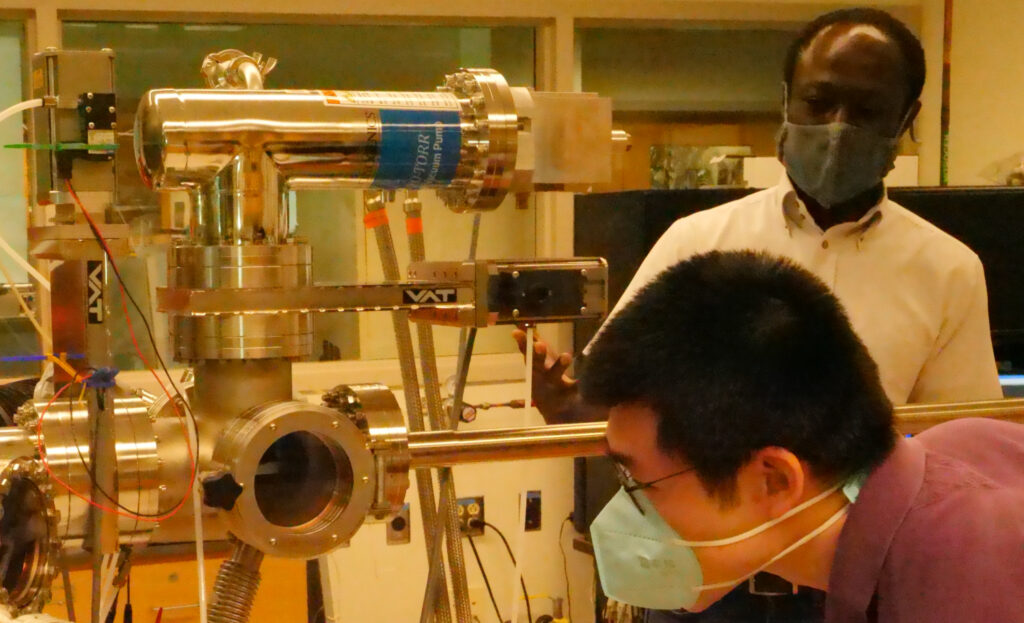
Probing nanoscale structures in ultrahigh vacuum: The preparation of nanostructures on crystal surfaces requires a ultrahigh vacuum environment to assure that the
contamination in air does not affect the properties of the structures. The (Nobel prize winning) technique of scanning tunneling microscopy is employed to develop a picture of the atomic
arrangement of nanostructures on surfaces.
Syncrotron Radiation: Soft X-Ray Photoemission, Core level shifts, Surface EXAFS for local structure, EXAFS of impurities in semiconductors, X-Ray Standing Waves.
Surface Vibrational Properties: Surface Enhanced Raman Scattering, Adsorbate Phonons and structure, Electron Energy Loss Spectroscopy, wavevector dispersion effects,
broadening and anisotropy in core level spectroscopies.
Recent Specific Projects
New Approaches to Photoemission Spectroscopy and Microscopy of Complex Oxides and Novel Transition Metal Surfaces: Studies of Ultra-thin Transition-metal Oxides and
Silicates, other Oxide and Oxy-Nitride Interfaces on Si(100) and Si(111) for new high-K gate dielectric applications. Some systems use catalyst growth methods as well as model bimetallic catalyst
systems, e.g., Pt, Pd, Au and Ir films on W (211) and Ir(210), which are studied with high-resolution photoemission at the Brookhaven NSLS. In 1995 Rowe discovered the Photon Channeling Effect in
the Far VUV and Soft X ray spectral region where total external reflection does not apply, and he demonstrated feasibility experiments in collaboration with N. V. Smith. He is currently developing
a new scanning microscope to study nanoscale electronic properties of Graphene, carbon nanotube, and diamond films on Si(111) and Si(100), Au/GaAs interfaces, III V quantum well structures, and
surface segregation of strained-structure SiGe alloys.
Electronic Structure and Microscopy pf Conducting Fulleride Carbon Nanotubes: Photoemission and LEED studies of aligned Carbon nanotubes including single-wall and
multiple-wall tubes, new methods of doping effects in Carbon Nanotube films, Graphene, Diamond, and superconducting C60 in order to determine band width and density of states. Epitaxial growth has
been achieved for several Carbon-based systems using hetero-structure film substrate combinations. Interface formation studies of C60 on several Cu, GaAs, and Si substrates indicate that novel 2D
films of C60 can be grown without indiffusion from the substrate for more than 1-2 monolayers.
Recent Publications
"Ultrathin Metal Films on W(211): Structure, Electronic Properties and Reactivity,"
Progress in Surf. Science
59.
J. J. Kolodziej. K. Pelhos, I. M. Abdelrehim, J. W. Keister, J. E. Rowe and T. E. Madey.
(1998). p. 117-134.
"Structure of Ultrathin SiO2/Si(111) Interfaces Studied by Photoelectron Spectroscopy,"
J. Vac. Sci. Tech.
A17.
J. W. Keister, J. E. Rowe, J. J. Kolodziej, H. Niimi, H.-S. Tao, T. E. Madey and G. Lucovsky.
(1999). p. 1250-1257.
"Band Offsets for Ultrathin SiO2 and Si3N4 films on Si(111) and Si(100) from Photoemission Spectroscopy,"
J. Vac. Sci Tech
B17.
J. W. Keister, J. E. Rowe, J. J. Kolodziej, H. Niimi, T. E. Madey and G. Lucovsky.
(1999). p. 1831-1835.
"The Effects of Interfacial Suboxide Transition Regions on Direct Tunneling in Oxide and Stacked Oxide-Nitride Gate Dielectrics,"
Microelectronic Engineering
48(1-4).
H. Yang, H. Niimi, Y. Wu, G. Lucovsky, J. W. Keister and J. E. Rowe.
(1993). p. 307-310.
|