
Areas of Interest
Most physical systems are not in equilibrium, but rather are subject to driving and/or dissipation. Far from equilibrium, where nonlinear effects become important, these systems display a rich array of complex behaviors. Systems can be dynamic, chaotic, or turbulent, and more remarkably can produce static patterns or exhibit persistent dynamics while remaining statistically stationary. Although there is typically no free-energy-like functional to minimize in a nonequilibrium system, quantities analogous to those used in equilibrium statistical mechanics can often elucidate the mean behavior.
Recent experiments address:
-- pattern formation and spatiotemporal chaos in fluid convection
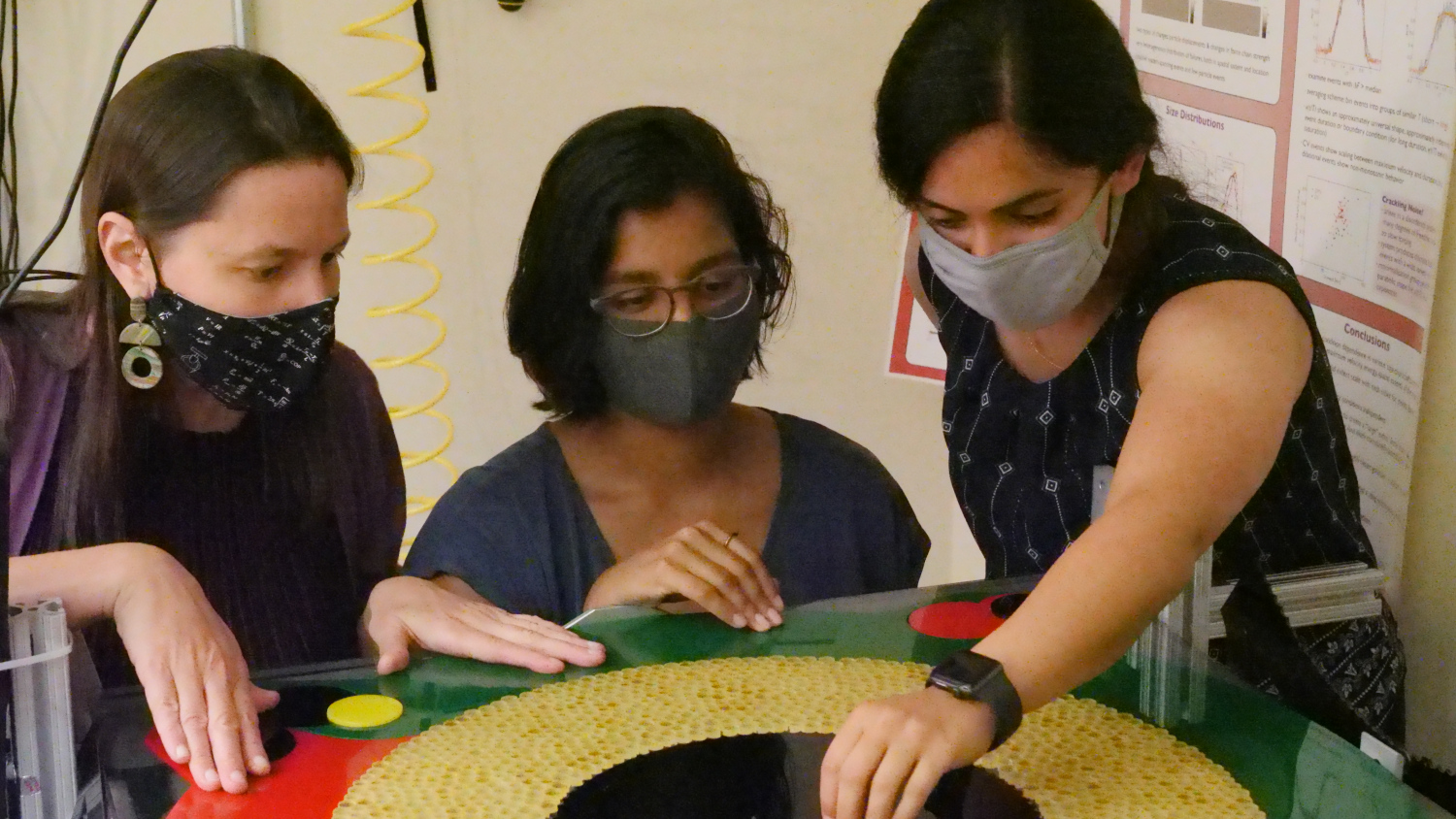
-- the statistical mechanics of granular materials
-- morphological instabilities in complex fluids
-- laboratory models of geophysical processes (earthquakes and meteor impacts)
Recent Publications
"A Porous Convection Model for Small-Scale Grass Patterns." Sally E. Thompson and Karen E. Daniels. The American Naturalist., 175: E10-E15 (2010). Click Here to view this publication.
"Mixing and segregation rates in sheared granular materials." L. A. Golick and K. E. Daniels. Phys. Rev. E., 80: 042301 (2009). Click Here to view this publication.
"Force chains in seismogenic faults visualized with photoelastic granular shear experiments." K. E. Daniels and N. W. Hayman. Journal of
Geophysical Research, 113: B11411 (2008). Click Here to view this publication.
"Instabilities in droplets spreading on gels." K. E. Daniels, S. Mukhopadhyay, P. J. Houseworth, and R. P. Behringer.
Physical Review Letters,99:124501, (2007). Click Here to view
this publication.
"Characterization of a freezing/melting transition in a vibrated and sheared granular medium,"
Journal of Statistical Mechanics.
K. E. Daniels and R. P. Behringer.
(2006). Click
here to view this publication.
"Hysteresis and competition between disorder and crystallization in sheared and vibrated granular flow,"
Physical Review Letters.
94.
K. E. Daniels and R. P. Behringer.
(2005). p. 168001. Click here to view this publication.
|