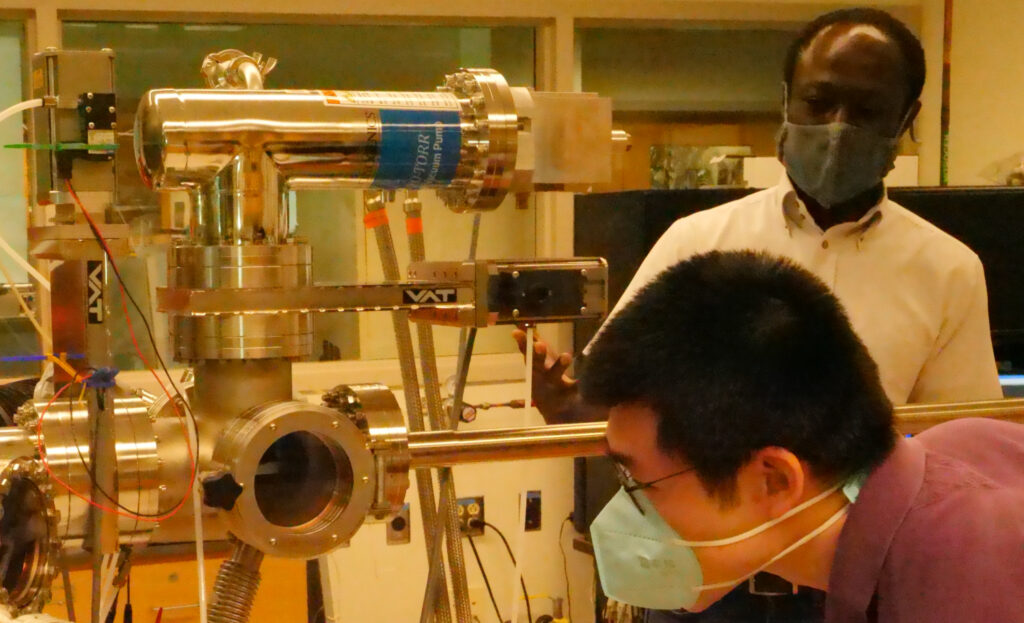

Our main program is in the area of atom cooling and trapping, which is currently focused on the study of atomic fermions. The central feature of our program is the use of all-optical methods to achieve quantum degeneracy. Our experiments employ an optical trap which consists of a single focused beam from a high-power ultrastable CO2 laser. Atoms are attracted to the highest intensity region near the focal point, where a potential well is formed. By employing an ultrahigh vacuum, trap lifetimes of 400 seconds are achieved. Forced evaporation in the optical trap is used to achieve quantum degeneracy.
This approach is ideally suited to exploring atomic gases with magnetically tunable interactions, as used in our experiments. Thus we can produce a Fermi gas with an interaction strength which can be tuned from zero to very strongly attractive or repulsive. We were the first group to realize a strongly interacting degenerate fermi gas in the BEC-BCS crossover region. Surprisingly, this strongly interacting atomic gas shares similarities to many other systems in nature, such as high-temperature superconductors, neutron stars, and the quark-gluon plasma. We were also the first group to observe evidence for superfluid Our research program strives to make model-independent, precise, measurements to aid in the theoretical understanding of these systems.
Perfect fluids are currently of great interest. As defined by a recent conjecture from the string theory community, perfect fluids exhibit a minimum ratio of the shear viscosity n to the entropy density s in strongly interacting scale invariant systems. Ultracold Fermi gases, tuned to a collisional (Feshbach) resonance, are strongly interacting and scale invariant, with thermodynamic and transport properties that are universal functions of the density n and temperature T. Measurements of the equilibrium properties, like the energy and entropy, currently test predictions employing state-of-the-art non-perturbative many-body methods. However, measurement and prediction of universal transport coefficients presents new challenges. In a recent Science paper(10.1126/science.1195219), we report the measurement of “Universal quantum viscosity in a unitary Fermi gas,�and compare the ratio n/s to that of a perfect fluid.
We are investigating a new regime of nonlinear hydrodynamics in quantum
matter. We collide two strongly interacting atomic Fermi gas clouds
and observe traveling shock waves. Our analysis of the data reveals
that for a strongly interacting Fermi gas, dissipative effects dominate,
in contrast to previous investigations into the dispersive properties
of weakly interacting BEC's.
We conducted an thermodynamic experiment on an
optically-trapped Fermi gas of atoms in the regime of strong
interparticle interactions to determine its heat capacity. In
addition to measuring the heat capacity of this unique physical system,
our study represents the first attempt at direct thermometry in the
strongly interacting regime. Making use of novel energy input and
temperature measurement techniques, we observe a transition in the heat
capacity which theory interprets as the onset of a high temperature
superfluid state. . . [read more]
Studies of collective modes in optically trapped gases are useful
because they allow us to infer information about microscopic
interactions by monitoring macroscopic observables. In our case, we
have studied the radial breathing mode in an optically trapped gas of
fermions in the strongly-interacting regime. The strength and sign of
the interactions between particles is controlled via application of an
external magnetic field. After cooling a gas of atoms well into
the degenerate regime . . . [read more]
We are the first group in the world to produce and study a strongly-interacting, degenerate Fermi gas of atoms. A cigar-shaped cloud of fermionic 6Li atoms is confined and rapidly cooled to degeneracy in our CO2 laser trap, using a magnetic field to induce strong interactions. Upon abruptly turning off the trap, the gas exhibits a spectacular anisotropic expansion, rapidly moving in the transverse direction while remaining nearly stationary along. . . [read more]