|
News Flash:
NCSU Astrophysics Researcher solves nearly 2000 year old mystery
In 185 A.D., Chinese astronomers noted a new "guest star" that appeared in the sky, by the 1960s, scientists determined that this was the
first documented supernova and pinpointed its location, and in 2011, NC State Astrophysicist researcher, and alumni of the Physics grad program, Brian
Williams tells us why it exploded, and why it's so large.
Link to article on the Physics news page
Link to to Brian's profile on the Alumni Profile page
Special Note: Fall 2012 Application:
Mark your calender. Recruiting event for admitted students is March 23 and 24.
The target date for priority consideration for Fall 12 has passed. In exceptional cases, we will accept US applications until June 25 and international applications until March 1
Program Overview: NCSU Physics has recently completed its faculty hiring goals of achieving near 100% research active faculty. This has resulted in significantly improved research support and improved quality and visibility of our research program with strengths in Astrophysics, Nuclear/High Energy Physics, Condensed Mater Physics/Nanoscience, Physics Education and new areas in Biophysics and Complex Matter. In turn, this research excellence allowed us to attract excellent students with a much improved rate of progress towards completion of a Ph.D. These improvements are very tangible when considering that the average subject GRE scores of enrolling US students improved over the last three years by ~200 points and the average GPA over the last two years is 3.75. Excellent individuals will be able to spread their wings at NCSU as far as they dare and are strongly encouraged to apply to become part of a dynamic and positive environment.
The Department of Physics at NC State is dedicated to providing an exciting
intellectual climate for our graduate students by advancing the frontier in pure
and applied physics and offering complementary courses. The Physics Department at
NC State has a diverse research program with strengths in Nanoscience, Nuclear Physics,
Astrophysics, Computational Physics, Optics, Biophysics, Materials Physics, and Physics
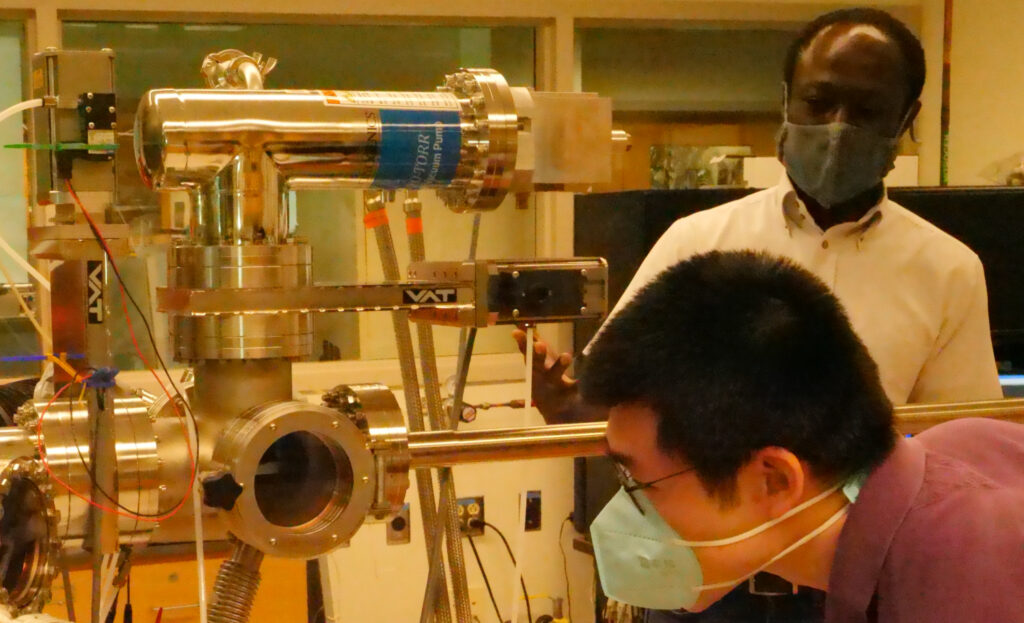
Education Research. The graduate program supports ~110 students. Well equipped research
labs are available in the recently renovated Riddick Hall, on the nationally renowned
NC State Centennial Campus and at the Triangle Universities Nuclear Laboratory. This
diversity of our research program offers excellent opportunities in most areas of
contemporary physics. We are committed to designing a program of graduate study
that is tailored to the background, experience and interests of individual students.
The goal of our program is to graduate fully functional professionals that can
conceive and execute experiments, analyse the results, grasp their significance,
and communicate them efficiently in peer-reviewed publications, posters and oral
presentations.
Physics At A Glance:
 |
- 44 research faculty engaged in forefront research in Nanoscience, Nuclear Physics,
Astrophysics, Computational Physics, Optics, Biophysics, Materials Physics, and Physics
Education Research
- Excellent graduate student to faculty ratio of 2.2:1
- Faculty Excellence
- 5 NSF Presidential Young Investigators/Career Awards
- 19 American Physical Society Fellows
- 2 DOE Outstanding Junior Investigators
- 1 Fellow of the National Academy of Science
- 3 Fellows of American Association for the Advancement of Science
- 2 Fellows of the Optical Society of America
- 3 Fellows of the American Vacuum Society
- Numerous other individual faculty Awards and Honors
- $7,757,182 of externally federally funded research in 2008-09 — $9,596,493 in total research expenditures
- Major participant in national and international research collaborations.
|
The department awards both masters (MS) and doctoral
(Ph.D.) degrees.
Demographically, the department boasts a diversity that includes many
international and female students. The African-American and native-American
proportions are several times the national average for graduate physics
programs.

Riddick Hall is home to the Physics Department offices as well as to the majority of research and teaching space.
The department occupies most of Riddick Hall, a 64,000
square-foot building that contains numerous research and instructional laboratories,
lecture rooms, offices, and a well-equipped instrument shop. In addition, the
contiguous NC State Centennial Campus houses
several departmental nano-science/materials laboratories, and the
CHiPS Center in several buildings.
Major facilities for nuclear physics research are provided by the
Triangle Universities Nuclear Laboratory.
General descriptions of our research programs may be found under our
research area descriptions.
Physics Department Graduate Programs Office
py-grad-program@ncsu.edu
204 Riddick Hall
North Carolina State University
Raleigh, NC 27695-8202
Phone 919-515-8706, fax: 919-515-3099
Link to Graduate Program Brochure [PDF]
|
Link to Grad Accomplishments
|